New Capitella paper out!

A giant congratulations to Max Hendershot for the publication of his undergraduate research in the WilsonToxLab! Max worked in the lab in summer after his 3rd year and did his 4th year thesis in the lab, before starting his MSc. Max’s research was with former PhD student Andrea Murillo Ramos and in collaboration with former PDF Andrew Thompson. Together, Andrea and Andrew designed a locomotory behavioural assay for our polychaete worms. Max’s project focused on extending this assay from adults into juveniles, which was needed if we were going to use this assay in the long run. Adult worms are large, so the original assay was in petri dishes, and our colony is really female biased, so trying to generate enough males to look at sex effects is super challenging. Instead, we moved the assay to juveniles in a plate based assay, which allows higher throughput.

Max’s project focused on trying to understand what neurochemical modulation could alter locomotion, using modulators of the dopamine, serotonin, GABA and acetylcholine pathways. This sets the stage for the lab to consider the impact of environmental contaminants that might alter these pathways. Check out his study “The marine worm Capitella teleta is sensitive to neurochemical manipulation, as revealed via a novel behavioural tool” in the Canadian Journal of Zoology. Its open access!
Happy Fish Nog Everyone!

Every December, the Biology Department gathers for a holiday party that is hosted by the physiologists: the McClelland, Scott, Choy, Little, and of course, WilsonToxLab. This holiday gathering, called Fish Nog, is a long tradition in Biology and the entire department really turns out. It is a fun event for our labs, with students organizing and contributing to the advertisement of Fish Nog. We all bring in some food to share, so the department is well fed. The physiology labs’ students also spend the early afternoon decorating our lounge, get the music going, and generally making sure that when the department arrives, everyone feels like they are walking into a party in progress. Of course, they also make sure the lounge is cleaned up after the party! Thanks to Hunter, who was the lead form our lab and made sure we had good music!

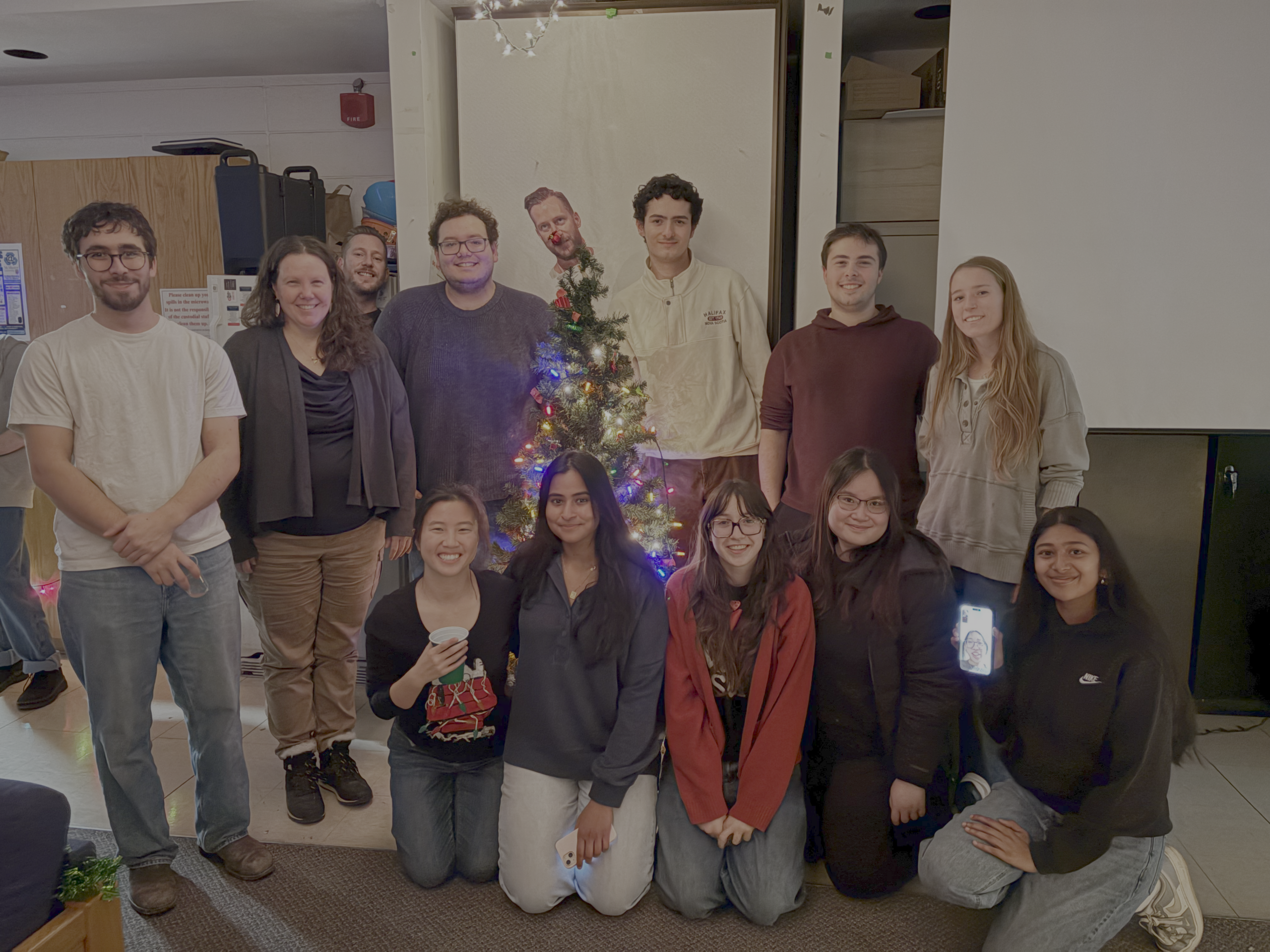
Of ocurse, we took the opportunity to get together and take a photo of the group. It was great to see some former students (in person & joining virtually!). Graduate students Jack, Molly, Emily, Hunter and Max were all there but also our UG trainees Lucas, Maddie, Clarice, and Ally. Raveena and Emily (on the phone) were in the lab last year. So glad they could join us. Alex Little is not there twice (although he is a twin…) but the students used his photo as a tree topper, and he snuck in behind us to join in!

the WilsonToxLab, old and new, were all gathered around the Christmas tree.  Alex Little's photo tops the tree but he is also peeking over my shoulder in a live photobomb.  One of our students from last year, Emily, even joined the photo through video chat on a phone!

ECR Spotlight

With the recent publication in the Journal of Experimental Biology, MSc student Mellissa Easwaramoorthy was featured in an ECR spotlight! Mellissa’s paper was entitled Elevated temperature during rearing diminishes swimming and disturbs the metabolism of yellow perch larvae. This research was from her undergraduate research in the lab, where she was involved in studies where we reared yellow perch embryos at different temperatures. Mellissa started as a 3rd year student in the lab, worked as a summer researcher for 2 years and completed her undergraduate thesis on this project. She looked at the effects of rearing environment on cardiac development, metabolism and behaviour in an important fish species. Yellow perch are a critical culture, ecological, and economic species for both recreational and https://journals.biologists.com/jeb/article/228/20/jeb251676/369589/ECR-Spotlight-Mellissa-Easwaramoorthy

Current Topics in Biochemistry Meeting

Joanna was off to Florinopolis Brazil last week and had an amazing time at the Federal University of Santa Caterina in Brazil. The trip thee was very long but worth the travel for such a great experience.

Beyond meeting new students and researchers, Joanna gave a talk on cytochrome P450 enzymes and our work to determine the function of these enzymes in zebrafish.

The weather was slightly warmer than Hamilton but the best part was that Florianopolis is full of beaches and ocean views and lots of seafood. My Brazilian hosts were amazing and I thank all the organizers for such a lovely meeting. I am hoping some collaborations are in our future!