Our Research

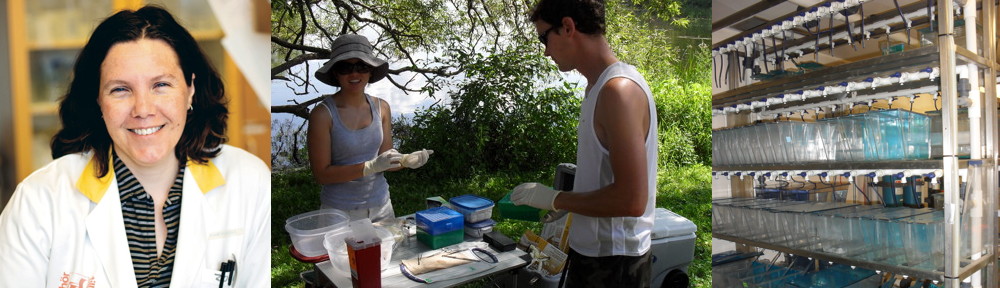
My research group focuses on both basic and applied areas of environmental sciences with a heavy interest in aquatic species.  My research intersects environmental physiology, toxicology, biochemistry, behaviour and bioinformatics and functional genomics.  We are typically asking questions that are environmentally relevant and design our experiments considering the use of the data for science policy or regulatory applications.

In our basic science, we study the evolution and function of cytochrome P450 enzymes in aquatic species.  This protein superfamily that is important for production and metabolism of steroid hormones, and is absolutely critical for xenobiotic (i.e. drugs, environmental contaminants) metabolism.  This work is essential to understand the potential for stressors to disrupt endocrine systems and to understand the toxicokinetics of xenobiotics.  We have studies in a wide variety of species, from cnidarians to fish!

In our applied science, we study the impacts of environmental stressors and have a large interest in chemical stress (especially human drugs) and temperature stress. In this research, we tend to focus on the impact of stressors on different life stages and important biological processes such as reproduction and development.

Please explore our associated research pages that describe the different areas of environmental science that our experiments address.

Recent Posts

Celebrating International Women’s Day with the Women in Science and Engineering Research Conference

Researchers from the WilsonToxLab and McArthur lab were amongst those presenting at the WISE conference on IWD in 2026! It’s so good to see new researchers taking each opportunity to share their research and talk about their science. Seen above, left to right, are Clarice (UG thesis student in WilsonToxLab), Amy (McArthur lab), Tina (McArthur lab), Molly (MSc in WilsonToxLab), Maddie (UG thesis student in WilsonToxLab) and Ally (UG thesis student in WilsonToxLab). Presentations were on the effects of chemical exposure in zebrafish or with a rainbow trout cell line. Clarice is studying the effects of chemical exposure in wild type and CYP3A65 knock out zebrafish; Ally has a similar project but with CYP1B1 knockout fish. Both projects are linking chemical metabolism to developmental toxicity outcomes. Maddie’s project is focused on developing reference toxicants for the RTgill-W1 assay to study whole effluent toxicity. Molly’s MSc is using 4 species of fish to examine the toxicity of PFAS precursors; chemicals that can be converted into PFAS in the environment by abiotic and biotic transformation. Her research will produce data to assess the environmental risk of PFAS precursors and assess the Fish Embryo Toxicity test for chemical toxicity, using a variety of model and native species.

  1. Mellissa Easwaramoorthy, MSc! Leave a reply
  2. Graduate Research Day Leave a reply
  3. Introducing ToxDRC, a new R package! Leave a reply
  4. New Capitella paper out! Leave a reply