Our Research

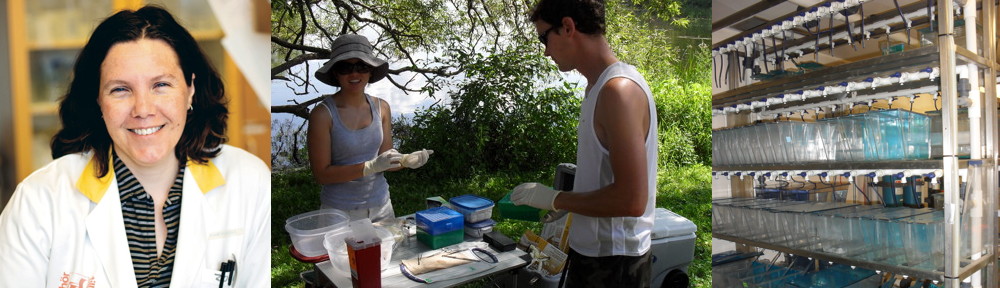
My research group focuses on both basic and applied areas of environmental sciences with a heavy interest in aquatic species.  My research intersects environmental physiology, toxicology, biochemistry, behaviour and bioinformatics and functional genomics.  We are typically asking questions that are environmentally relevant and design our experiments considering the use of the data for science policy or regulatory applications.

In our basic science, we study the evolution and function of cytochrome P450 enzymes in aquatic species.  This protein superfamily that is important for production and metabolism of steroid hormones, and is absolutely critical for xenobiotic (i.e. drugs, environmental contaminants) metabolism.  This work is essential to understand the potential for stressors to disrupt endocrine systems and to understand the toxicokinetics of xenobiotics.  We have studies in a wide variety of species, from cnidarians to fish!

In our applied science, we study the impacts of environmental stressors and have a large interest in chemical stress (especially human drugs) and temperature stress. In this research, we tend to focus on the impact of stressors on different life stages and important biological processes such as reproduction and development.

Please explore our associated research pages that describe the different areas of environmental science that our experiments address.

Recent Posts

New Capitella paper out!

A giant congratulations to Max Hendershot for the publication of his undergraduate research in the WilsonToxLab! Max worked in the lab in summer after his 3rd year and did his 4th year thesis in the lab, before starting his MSc. Max’s research was with former PhD student Andrea Murillo Ramos and in collaboration with former PDF Andrew Thompson. Together, Andrea and Andrew designed a locomotory behavioural assay for our polychaete worms. Max’s project focused on extending this assay from adults into juveniles, which was needed if we were going to use this assay in the long run. Adult worms are large, so the original assay was in petri dishes, and our colony is really female biased, so trying to generate enough males to look at sex effects is super challenging. Instead, we moved the assay to juveniles in a plate based assay, which allows higher throughput.

Max’s project focused on trying to understand what neurochemical modulation could alter locomotion, using modulators of the dopamine, serotonin, GABA and acetylcholine pathways. This sets the stage for the lab to consider the impact of environmental contaminants that might alter these pathways. Check out his study “The marine worm Capitella teleta is sensitive to neurochemical manipulation, as revealed via a novel behavioural tool” in the Canadian Journal of Zoology. Its open access!

  1. Happy Fish Nog Everyone! Leave a reply
  2. ECR Spotlight Leave a reply
  3. Current Topics in Biochemistry Meeting Leave a reply
  4. WilsonToxLab attends the Canadian Ecotoxicity Workshop Leave a reply